What is Copyright?
Copyright is often a very intimidating topic for many people, especially in a digital age where almost everything can be shared quickly and easily. What is copyright, and how does it work? According to the U.S. Copyright Office, copyright is “a type of intellectual property that protects original works of authorship as soon as an author fixes the work in a tangible form of expression.” In other words, anyone can be a copyright owner as long as the work is created by them and is fixed in a permanent medium. Copyrighted works can include, but are not limited to: photographs, musical compositions, computer programs, plays, architectural works, and even blog posts (like this one)!
Works are copyrighted by default in any instance of an original work that is fixed. Although it is voluntary, officially registering your works can add extra protection for things like exclusivity in use cases. Ultimately, copyright is an important part of representing and preserving individual creative expression.
Sharing Creations with Creative Commons
Creative Commons (CC) is another form of copyright, specifically for people who wish to share their creations with the wider public. The licenses are standardized, telling you how to credit the owner, whether or not you can use it commercially, and if you can modify it in any way. The license you choose for your work depends on how you want it to be used and why it’s being shared. Anyone can use CC for their copyrighted work, and once the license is created it cannot be revoked. And for those who are feeling particularly charitable, there is the public dedication tool called CC0 (CC Zero), where creators can give up the copyright of a work and place it in the public domain for people to reuse without any conditions.
There are many people who have contributed their works to the Creative Commons—you may even have been viewing and using them already! Have you ever visited a Wikipedia page for a painting? How about a photograph on Flickr? All of these images are all protected under CC licenses!
My Contribution
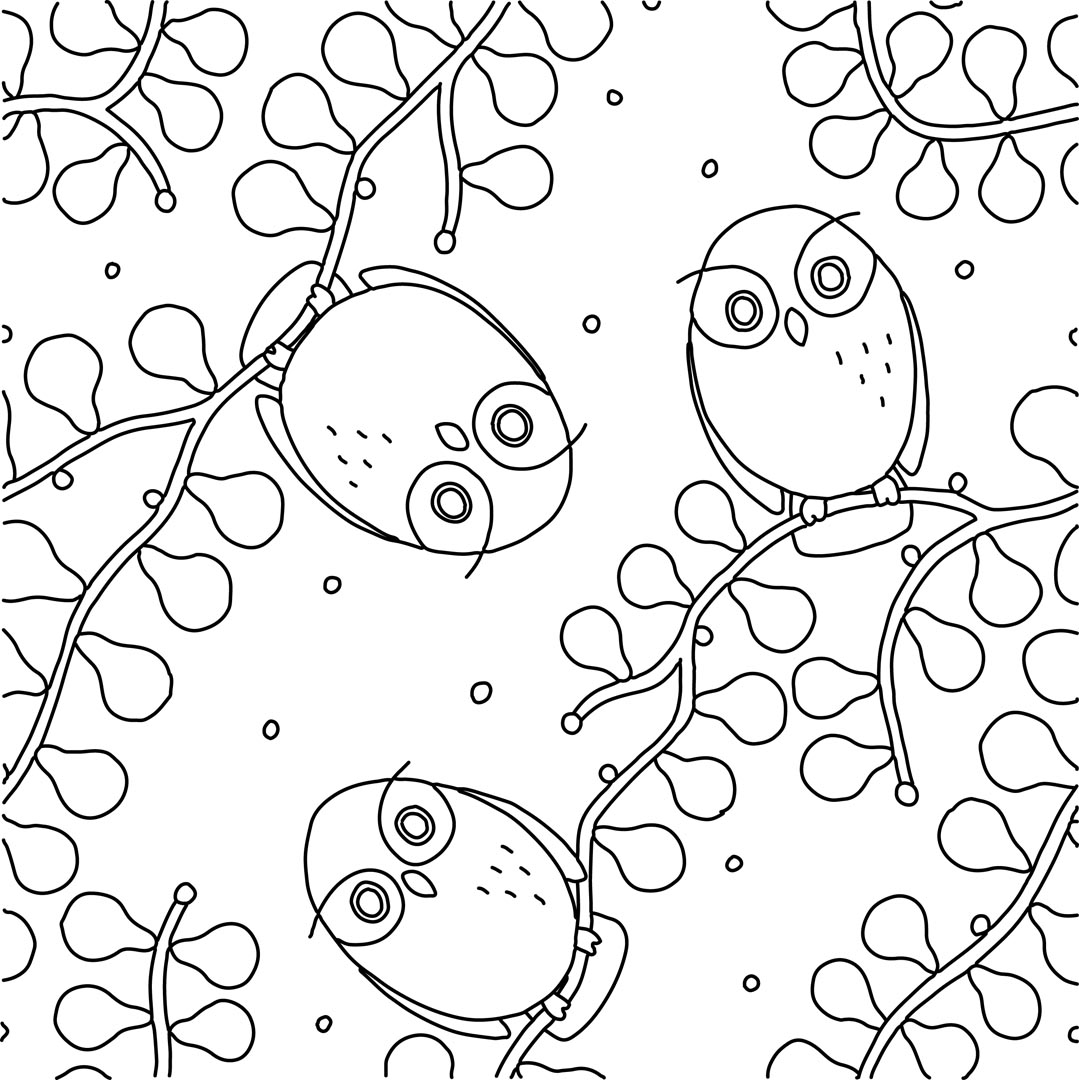
With all of the potential works I could share with the wider public, I decided to create a repeating pattern. I created a design on paper that would be scanned and digitized for use as a background for a website, to give an example. I also kept the linework in the piece imperfect to preserve the “hand drawn” feeling of the piece. After watching and reading more about the different types of CC licenses, I knew that I wanted the people who reused my work to credit back to me, and only use it for non-commercial purposes. However, I was torn on what else I would feel comfortable allowing, so I used the official chooser on the Creative Commons website to help me determine the license that best suited my needs.
The final piece is a digitized version of a black and white drawing. It is a repeating pattern featuring owls perched on thin branches with pears going on them. This work is licensed under CC BY-NC-SA 4.0, meaning the work can be remixed, adapted, built upon for non-commercial purposes, as long as the edited work is shared under the same terms and attribution is given to the original creator (that’s me!). The image can be seen below.