Islamic architecture is among the most recognizable in the world, with mosques being the most notable example. In this paper, I will explore how mosques as an architectural space contribute to spirituality. I will look at sources that cover the history of mosques as a space and how they developed, as well as the architecturally aesthetic aspect of them. This study will employ literary and visual analysis of scholarly sources. This paper argues that mosque design achieves a sense of spirituality through the use of light and the geometric structure of the building. This point will be further proved through comparison of mosques throughout time, exploring how they accomplish the same goal of providing spirituality in different ways. The significance of this argument lies in the fact that despite the popularity of Islamic architecture in the modern day, the meanings and intentions behind it are not well known.
Mosques, or masjids, are a Muslim place of worship. This does not necessarily mean that it is a building, and prayer can take place anywhere for as long as a person needs. As Islam spread and progressed, so did the mosques that came along with it. Each region put their own twist on the appearance of the mosque, while still staying true to the purpose of the building. As we continue to move forward in the present day, architects are continuing to push the boundaries of traditional design and even breaking away from it entirely.
In order to support my point, this paper is divided into three sections, two of which will have sub-sections. In the first section, I will cover the history of mosques and how they developed over time. In the second section, light and geometry as they are applied in mosques are explored in depth individually, with an emphasis on how they add to a feeling of spirituality in a mosque. Lastly, I compare different mosques with a focus on the use of light and geometry in the space to show how different mosques styles can still bring a sense of spirituality with these elements employed. It is through these sections that I argue towards the importance of light and geometry in mosque design. Before getting into comparisons, however, I must begin with why mosques exist.
History and Development of Mosques
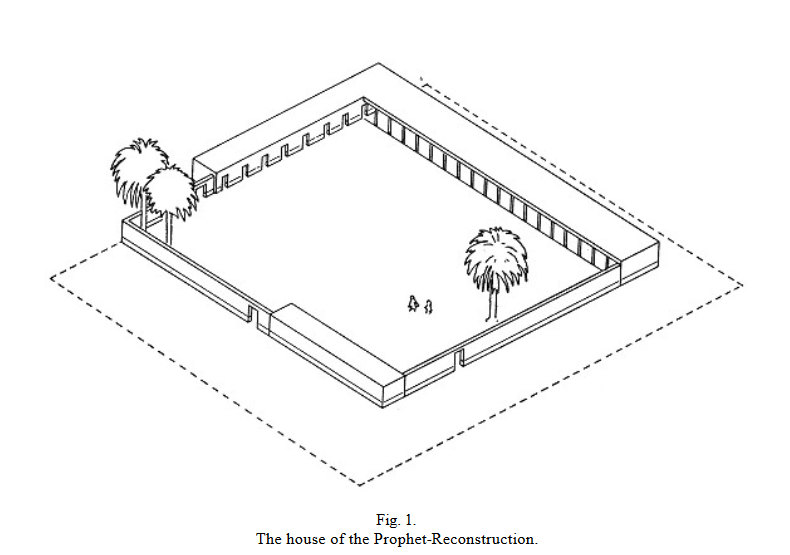
Mosques have a long history dating back to the life of the prophet; although mosques did not exist in the same way as they do today, they still had spiritual significance. The significance of this lies in the simplest definition of a mosque, which is “a wall correctly oriented towards the qibla, namely the Ka’ba within the Masjid al-Haram, Mecca” (Hillenbrand 31). This could be simplified even further, as even the wall itself is not a necessary component as long as there is a line in the sand that is perpendicular to the line going towards Mecca (Al-Asad 30). According to Erzen, a mosque is “an ideal place where all tensions are brought to equilibrium and harmonized,” implying that mosques are meant to bring a spiritual peace (127). Along with serving as a space for collective worship, mosques also served multiple other distinct purposes, though these were eventually moved to separate buildings associated with the mosque (Kuban 2). The Umayyad period following the death of the prophet saw architecture of mosques that was based on the prophet’s house in Medina (Al-Asad 30). This point is important, as many of the components that form the interior of mosques were based off of the prophet’s house, such as the minaret, which is used to signal the time for prayer (40). Aside from the basic components of a mosque inspired by the prophet’s house, much of the design of mosques is left to imagination. As Islam spread across the world, various regions developed different mosque styles, all of which have religious intent in the forefront of their design (Hillenbrand 32). As I will explain in the following paragraphs, I believe that these religious intentions show up prominently through the application of light and geometry.
Applications of Light and Geometry
In the many components that characterize a mosque, light and geometry play an important role in the design. Both of these elements in a mosque, together and individually, impact the general feeling of the building. In the sections below, light and geometry are explored as they help contribute to an atmosphere that brings spirituality to a mosque.
Light in Mosques
Light is an essential aspect of any type of architecture; for practical purposes, it allows you to see in a space and navigate your way through it, but in addition it gives the spectator a specific feeling about a space. In mosques specifically, the use of light and how it’s manipulated not only as a way to light the space, but also brings a sense of spirituality to the building through fostering feelings of peace and a connection to god. In Islam, light is “responsible for making the material transparent and reducing the solidness and coldness of the building” (Matracchi and Habibabad 1). In essence, alongside serving as a tool used to illuminate the space, it also symbolizes the divine light and glory of God that guides people. Light turns man-made structures into something sacred, allowing the “comprehensible interpretation” of God through light to enhance the spirituality of the mosque (Matracchi and Habibabad 2).
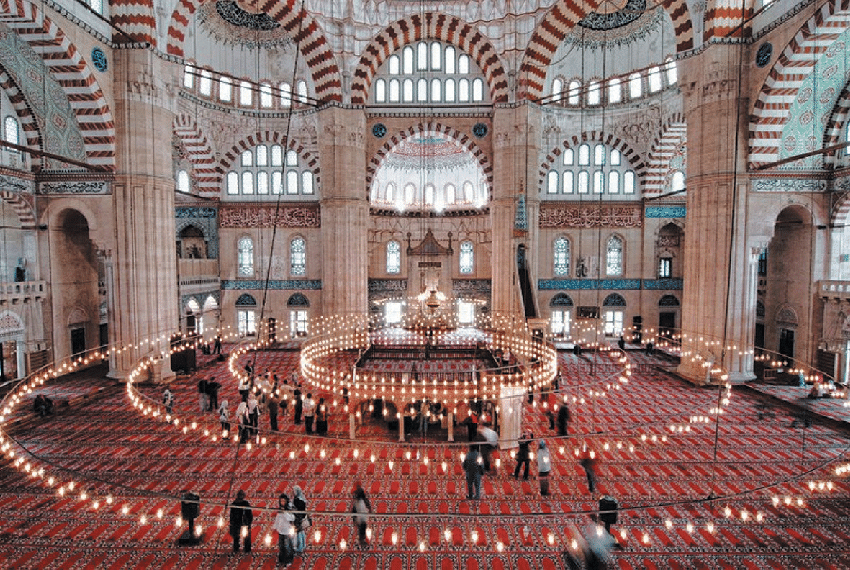
One example of how light is utilized to create a spiritual atmosphere is in the Selimiye Mosque, located in Edirne, Turkey. Its spectacular use of light is reinforced by the fact that only a single dome is present, coupled with the “use of coloured glass and double windows with grates on the outside” (Arel and Oner 424). Given the structural form of the mosque not having to rely on holding up the dome, the light is able to flow in more freely, giving a sense of spirituality and closeness to God in the even distribution of light in the area with no sense of the direction the light is coming from (424). Along with the light, the space was also used to emphasize the effect of its spirituality with the implementation of tinted colors and reflective materials (425). Light in mosques makes for more spiritually inclined spaces, and it also works in tandem with the geometry found within the structure of a mosque.
Geometry in Mosques
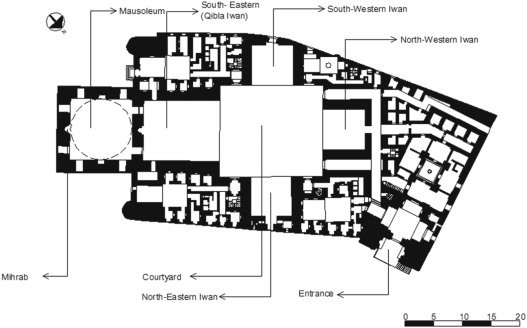
Just as light is influential to the spirituality of a mosque, the form it takes in its geometrical structure is equally important, contributing to the various forms of mosque designs that exist in the world today. Geometry in the realm of Islamic architecture was allowed to be more flexible, which were “used to provide general guidelines” instead of hard-and-fast rules that needed to be followed every time (Al-Asad 55). That being said, mosques would take on more rectangular formations to accommodate for the large groups of worshippers that would be arranged in rows (56). Of course, due to a variety of reasons such as land restrictions, mosques do not always follow this pattern. Nevertheless, the mosques that result from them still make for spaces that foster spirituality. This includes the Selimiye Mosque, whose prayer-hall has a set of piers forming an octagonal shape that still fits within a rectangular structure (56). And as mentioned in the previous section on light, this arrangement still brings spirituality to the mosque, as it affects the way the light flows into the building. Another exception to the rectangular form of a mosque is the Dome of the Rock in Jerusalem, which features an octagonal shape for the base from two squares (57). Additionally, land restrictions have also affected the symmetry of mosques over time, particularly for those that have had additions built on. For example, with the Great Mosque of Isfahan, the part of the building with the courtyard and the four iwans are “symmetrically arranged along the longitudinal axis, [but] the symmetry breaks up as one moves away from the centre” (58).
The exceptions to the general rectangular form are emphasized, because even when the mosque designs have to deviate from a certain form, they still provide an architectural experience for the worshiper. As land restrictions are one of the most important factors that determine the design of a mosque, the architects of those within an urban area have to contend with satisfying the different directions of the qibla as well as the street adjacent to the mosque. An example where both of these factors were satisfied in the design was the Mosque of Sultan Hasan in Cairo (Al-Asad 60). By making use of a “broken axis,” the entrances of mosques can be extended to axes that shift and make the entry into the mosque a more dynamic one that evokes an experience. This can also go hand in hand with the application of light in the space, as a way to guide those to the courtyard or prayer-hall, contributing to a more meaningful and spiritual experience right as you enter. With that being said, we can begin to explore examples of mosques in history that effectively utilize light and geometry in their design.
Comparisons in History
With the spread of Islam across the world, the religion has intersected with many different cultures. As a result, mosques have had many different styles that reflect the time it was built in as the architects attempted to create a space to serve as a place of worship for Muslims that also reflected the dominant culture. In the next two sections, I will discuss the Great Mosque of Cordoba and the Sheikh Lotfollah Mosque in terms of their use of light and geometry in the space that encourages a sense of spirituality.
Great Mosque of Cordoba
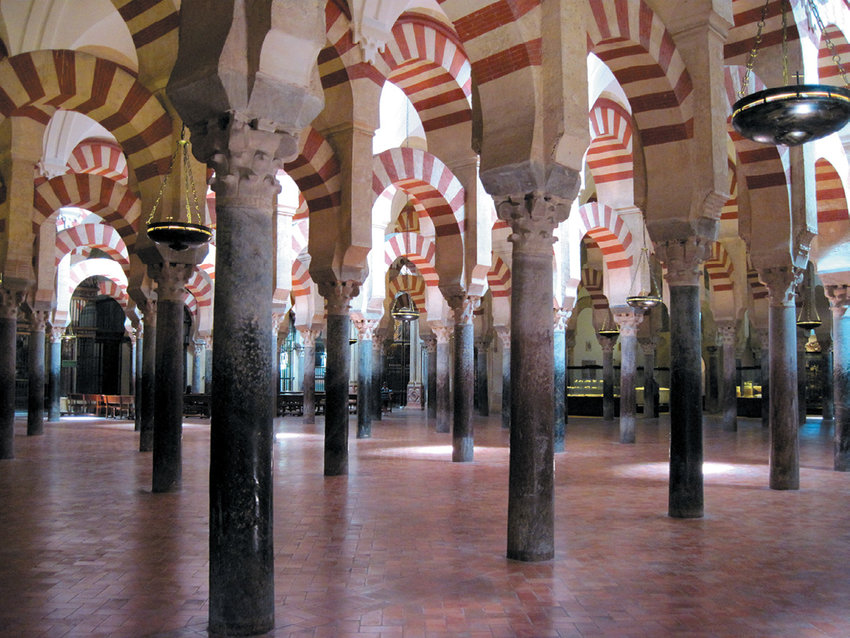
Built in 785, the Great Mosque of Cordoba was unique for its time and continues to be in the modern day. The mosque has an “arcaded hypostyle hall” made up of 856 columns, which act as a support for the double arches that fall in between. This structure allowed for “higher ceilings in comparison with the standards” (Arel and Oner 425). Because of this structure, the way light functions within the mosque is different, affecting the way the experience of spirituality. In this mosque, light does not get distributed equally across; rather, a mixture of light and shadow highlights the presence of God through divine light as it is filtered through grilled windows. In the Great Mosque, light is a feature in the space that is both decorative and symbolic of spirituality (426). Going back to the structure of the Mosque, the columns, which divide the space within the mosque remove a sense of oneness from this building, subverting the sense of connection and community that is usually found in other mosques. However, in place of the feeling of “one” in the mosque, the Great Mosque’s structure provides in its place a space for individual worship and connection with God, and with “providing a feeling of one person not being superior to the other in the presence of God” (425).
Sheikh Lotfollah Mosque
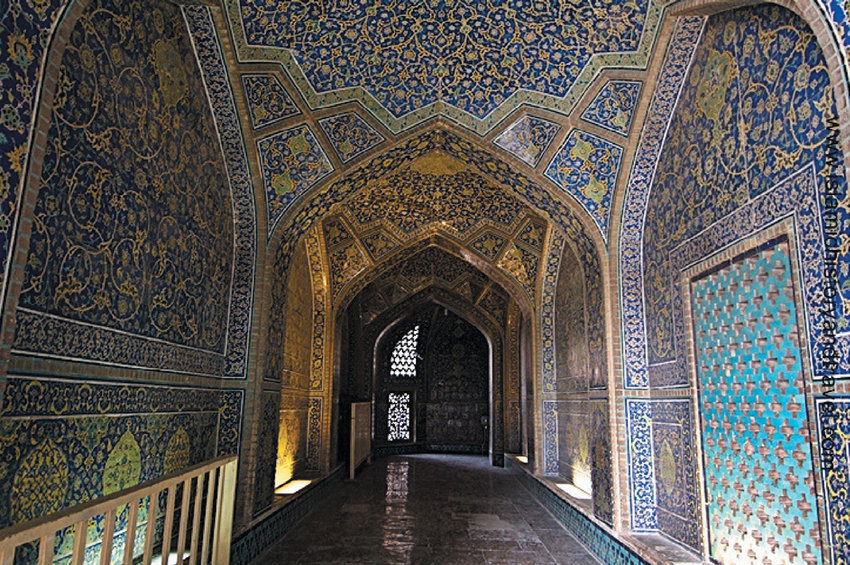
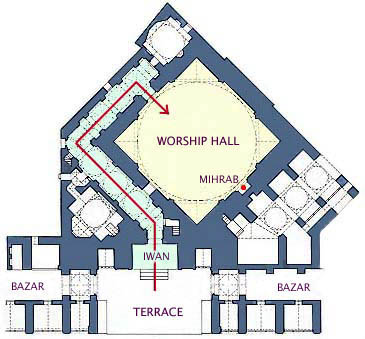
The Sheikh Lotfollah Mosque, erected during the Safavid Empire and located in Isfahan, Iran, is notable for its lack of minarets and a courtyard. The mosque’s way of employing light in the space also differs from the Cordoba Mosque, as instead of an area where the flow of light is diffused through pillars, the goal is to guide worshippers to the presence of God (Arel and Oner 427). This is most deliberately shown through the use of light in the entrance to the mosque, which is only accessible through steps; the main source of light for the interior is from “the vaulted opening above the entrance,” as well as windows placed along the walls to reinforce an atmosphere that implies that of the divine (427). What the entrance provides in terms of structure also allows a more dynamic and spiritual experience (Al-Asad 60). This is further enhanced by the mosque’s use of light hierarchies, in which the entrance is followed by a “dark and narrow corridor,” where the divine light found at its end will connect it to the rest of the mosque and in turn a connection to God (Arel and Oner 428). In both the Great Mosque and the Sheikh Lotfollah, the application of light is not on its equal distribution in the area, but instead on more intentional placements on how it lights the area. Additionally, the structural geometry of the mosques, such as the dome for the Sheikh Lotfollah and the columns for the Great Mosque, not only affect the passage of light through the mosque but contribute to the spiritual experience of the worshippers present, either by providing a space to connect with God individually or through guiding them to a space where it can be done communally.
Conclusion
This paper opens with the history of mosques and how they developed over time, discussing how they first came to exist and how designs were influenced as the religion grew. In order to understand the designs of mosques as they are today and have been throughout time, mosques need to be examined as they were understood to function both during and after the prophet’s lifetime. The second section covered light and geometry as they are applied within mosques and how they help foster a sense of spirituality. This is important because both light and geometry are essential aspects of Islamic architecture, but feature most prominently in mosques. The third and final section covers two mosques from different periods and countries, exploring how they utilize aspects of light and geometry specifically. Through discussing these mosques, we can see how they apply these aspects differently while still accomplishing their goal of creating a spiritual environment. By creating a space in mosques that utilize light and the geometric structure of the building, mosques can better contribute to a feeling of spirituality in its patrons. This paper contributes towards this conversation on spirituality in mosques and Islamic architecture to spread awareness of the topic of the spiritual significance of mosques and how they can show up in more than just color and interior design.
Work Cited
Al-Asad, Mohammad. The Mosque: History, Architectural Development & Regional Diversity. Edited by Martin Frishman and Hasan-Uddin Khan, Thames and Hudson, 1994. WorldCat Discovery Service, www.agnesscott.on.worldcat.org/search/detail/31932984?queryString=su%3A%20Mosques%20Designs%20and%20plans&clusterResults=true&groupVariantRecords=false. Accessed 6 Nov. 2022.
Arel, H. S., and M. Öner. Use of Daylight in Mosques: Meaning and Practice in Three Different Cases. 2017.
Erzen, Jale Nejdet. “Reading Mosques: Meaning and Architecture in Islam.” The Journal of Aesthetics and Art Criticism, vol. 69, no. 1, 2011, pp. 125–31. JSTOR, www.jstor.org/stable/42635843. Accessed 1 Nov. 2022.
Hillenbrand, Robert. Islamic Architecture. Edinburgh University Press, 2000. WorldCat Discovery Service, www.search.ebscohost.com/login.aspx?direct=true&scope=site&db=nlebk&db=nlabk&AN=2398211. Accessed 11 Nov. 2022.
Kuban, Doğan. The Mosque and Its Early Development. Brill, 1974. WorldCat Discovery Service, www.agnesscott.on.worldcat.org/search/detail/1257170?queryString=su%3A%20Religious%20architecture%20Islamic%20countries&clusterResults=true&groupVariantRecords=false. Accessed 11 Nov. 2022.
Matracchi, Pietro and Ali Sadeghi Habibabad. “Prioritizing the Effect of ‘Light’ in the Religious Places and Environments with an Emphasis on the Sense of Spirituality.” Ain Shams Engineering Journal, vol. 13, no. 1, 2022, p. 1-12.